- TPD discharge is a federal program built specifically to cancel student loan debt for qualifying disabled veterans.
Read full summary ▾
- Two VA disability determinations can make a veteran eligible, and one requires no separate proof beyond existing VA paperwork.
- The Department of Education can discharge eligible loans automatically, without the veteran ever filing an application.
- A 2026 tax rule change makes TPD discharge meaningfully different from other student loan forgiveness this year.
This guide covers who qualifies for a TPD student loan discharge, how it gets processed, and what the 2026 tax rules mean for a veteran receiving one.
For a veteran managing a service-connected disability, federal student loan debt can feel like one more obligation layered on top of an already difficult transition. VFW National Home works with veteran and military families dealing exactly this kind of overlap. Total and Permanent Disability (TPD) discharge is a federal program that cancels student loan debt for veterans who meet the federal disability standard.
Clearing that debt is one piece of a bigger picture. VFW National Home offers VA benefits guidance and referrals nationwide, plus structured education support for veterans on campus.
Table of Contents
- What is a TPD student loan discharge?
- Which veterans qualify for the TPD discharge program?
- Which loans are eligible for TPD discharge?
- How do you get a TPD student loan discharge?
- Is the discharge taxable in 2026?
- What should you do after your loans are forgiven?
- What other support is available to veteran families?
- Frequently asked questions
What is a TPD student loan discharge?
A TPD discharge cancels a borrower’s federal student loans if they meet the federal definition of total and permanent disability. It’s administered by the U.S. Department of Education, not the VA, through the TPD discharge program.
- The VA determines and documents the disability rating.
- The Department of Education uses that determination to decide whether the student loan gets discharged.
Which veterans qualify for the TPD discharge program?
A veteran generally qualifies if the VA has determined they’re unemployable due to a service-connected condition, through one of two ratings:
- A service-connected disability rated 100% disabling
- A rating of Total Disability based on Individual Unemployability (TDIU)
The VA’s own determination, documented through a benefit summary letter, is the qualifying evidence. Veterans don’t need to separately prove disability to the Department of Education.
Which loans are eligible for TPD discharge?
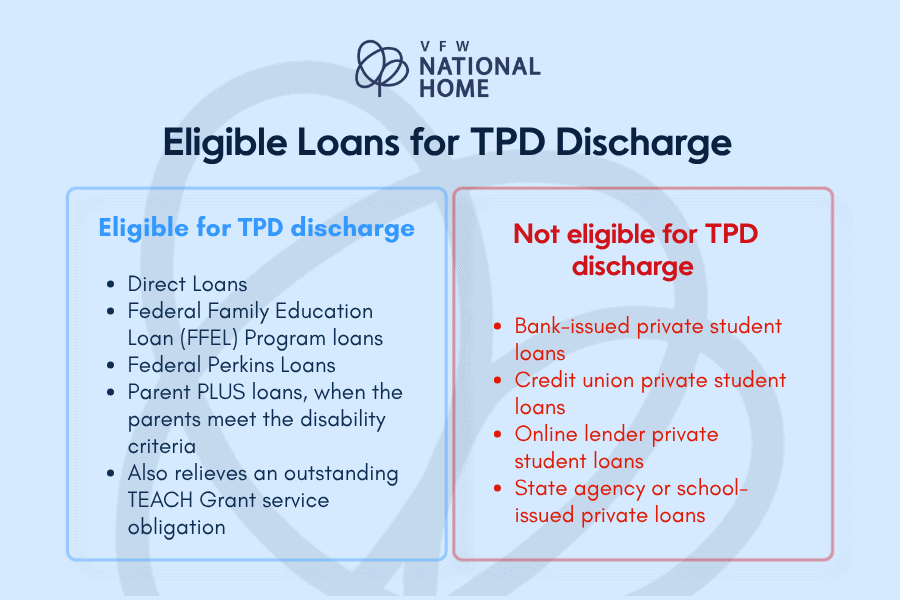
Nearly all federal student loans qualify:
- Direct Loans
- Federal Family Education Loan (FFEL) Program loans
- Federal Perkins Loans
- Parent PLUS loans, when the parent is the one who meets the disability criteria
A TPD discharge also relieves a borrower from an outstanding TEACH Grant service obligation.
Not eligible for TPD discharge
- Bank-issued private student loans
- Credit union private student loans
- Online lender private student loans
- State agency or school-issued private loans
Private student loans fall outside the federal program entirely. Some private lenders offer their own disability discharge policies, so a veteran would need to check directly with that lender.
How do you get a TPD student loan discharge?
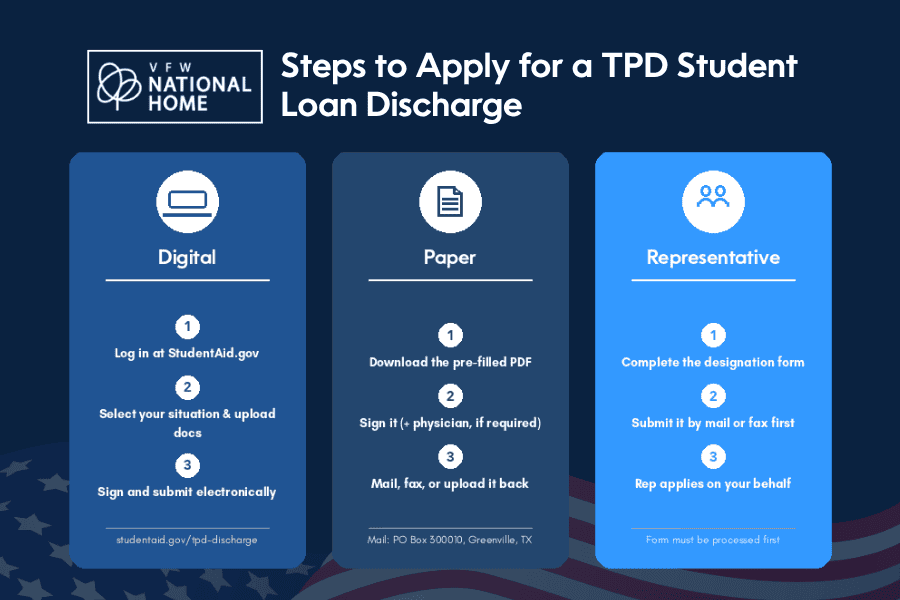
If you haven’t received an automatic discharge letter, you can apply digitally through the TPD Application page, by paper, or have someone else apply on your behalf.
Automatic discharge through data matching
Most eligible veterans don’t need to file anything. The Department of Education regularly runs a data match against VA disability records and discharges qualifying loans automatically, unless the veteran opts out. This traces back to a 2019 presidential memorandum directing the Departments of Education and Veterans Affairs to simplify a previously application-heavy process.
Applying directly
- Log in to StudentAid.gov and go to the TPD Application page.
- Select the option that matches your situation on the disability information page.
- Upload your supporting documentation when prompted.
- Sign and certify the application electronically.
If you’re using a physician’s certification and provide their email, the site sends your physician a link to sign and certify electronically.
Applying by paper
Complete the same first three steps as the digital process, then choose the manual signature option instead of signing online. The site generates a pre-filled PDF for you to download.
- Download and print the pre-filled application.
- Sign it.
- If applicable, have your physician sign it too, using one of three accepted formats: a signature drawn on a signature pad, mouse, or finger; a scanned photo of a signature drawn on paper; or an original ink signature.
- Submit the signed application by mail, fax, or upload through your StudentAid.gov account.
Mailing address: U.S. Department of Education, P.O. Box 300010, Greenville, TX 75403 Fax: 540-212-2415
You can also skip the online form entirely and download a blank application to fill out by hand, then submit it the same way. This route typically takes longer to process.
Having someone apply for you
A family member or an organization, such as a veterans’ service organization, can complete and submit the application on your behalf. Both you and your representative need to complete and sign an Applicant Representative Designation form first. The Department of Education won’t work with your representative until this form is processed, so it needs to be submitted (by mail or fax) before they can act on your behalf.
Steps to apply directly:
- Gather your documentation. Get your VA benefit summary letter from your VA.gov account, showing your 100% Permanent and Total rating or TDIU status.
- Start the application. Submit it through your StudentAid.gov account or by mail, fax, or upload.
- Select the VA disability pathway. On the application, choose the option for VA-based eligibility rather than SSA or physician certification.
- Upload or attach your VA documentation. This is what the Department of Education uses to verify eligibility.
- Sign and submit. Sign electronically through your account, or print, sign, and mail a paper copy if you prefer.
- Wait for confirmation. The Department of Education will notify you once the discharge is approved and your loan balance is updated.
Processing time varies. Automatic discharges usually move faster since there’s no application to review, while direct applications take longer if additional documentation is needed. A loan servicer can give the most accurate estimate for a specific case.

Is the discharge taxable in 2026?
No. TPD discharge is permanently exempt from federal income tax under Internal Revenue Code Section 108(f)(5), the same IRS rules on discharged debt that apply to other cancellation-of-debt situations.
This is a meaningful distinction in 2026 specifically. A temporary American Rescue Plan provision made most federal student loan forgiveness tax-free from 2021 through the end of 2025. That exemption expired on December 31, 2025, and forgiveness under income-driven plans is now taxable again for most borrowers.
TPD discharge was never tied to that temporary provision. It sits under a separate, permanent exclusion, so a veteran discharged this year still won’t owe federal tax on the forgiven amount.
State tax treatment varies, so it’s worth checking with a tax professional about how a specific state handles the discharge.
What should you do after your loans are forgiven?
Approval isn’t quite the finish line. A few follow-up steps can help you make sure everything’s set and finalized:
- Confirm it went through. Keep the discharge approval letter and confirm the loan balance updates through the Federal Student Aid account and the servicer.
- Ask about refunds. Some borrowers can get a refund of payments made after their disability determination’s effective date, depending on the discharge pathway. It isn’t automatic, so ask the servicer directly.
- If denied, you can reapply. Updated documentation, such as a more recent VA letter, often resolves the issue that caused the denial.
What other support is available to veteran families?
Getting a student loan discharged removes one financial obligation, but it doesn’t address the rest of what many veteran families are managing at the same time: housing, career transition, and childcare.

VFW National Home offers that broader support. Families who qualify for the on-campus program in Eaton Rapids, Michigan move through the Red, White & Blue Program, a phased, time-limited framework pairing free case management with goals around financial stability, education, and career development.
Families can start an application directly! For veterans anywhere in the country, our nationwide support program offers VA benefits guidance, referrals, and peer programs. One family’s story shows what that support can look like in practice.
Take the next step with VFW National Home
Once the loan is off your plate, other questions tend to surface about benefits, education, or what’s next. VFW National Home is set up to help with all of it!
Frequently asked questions
Can a veteran get student loan forgiveness?
Yes. Veterans with a 100% Permanent and Total VA rating or TDIU can qualify for a TPD discharge that cancels most federal student loans, often automatically through a VA data match.
Is there debt relief for disabled veterans?
Yes, though TPD discharge specifically covers student loans. It’s separate from other VA debt relief, like overpayment waivers, which involve different agencies and processes.
Is a TPD discharge taxable?
No. TPD discharge is permanently exempt from federal income tax. State tax treatment can vary, so it’s worth checking with a tax professional.
Who is eligible for student loan forgiveness?
Eligibility comes down to one of two VA determinations: a 100% disabling rating, or TDIU. No separate proof is needed beyond the VA’s own documentation.
What if my federal student loans are already in default?
Many borrowers in default can still qualify. If approved, the discharge can eliminate the qualifying debt even while in default, though it’s worth confirming how collections are handled while an application is pending.