- The SpouseWorks Scholarship (formerly MyCAA) offers up to $4,000 toward a license, certification, or associate degree.
Read full summary ▾
- Post-9/11 GI Bill benefits can transfer from a service member to a spouse, who can start using them right away.
- MSRRA, a federal law, lets military spouses keep their home-state residency after a move, which can qualify them for in-state college tuition.
- VFW National Home’s on-campus Education program supports the whole family, not just tuition costs.
This piece walks through the main federal programs available to military spouses pursuing a degree, certification, or license, including how each one works and what it actually covers. It also looks at what’s available to families facing challenges bigger than tuition, and how VFW National Home’s on-campus program supports the whole family through that process.
Going back to school can look a little different for military spouses. They may have to transfer schools after a move, adjust their classes around a deployment, or rethink their career plans at a new duty station. School may take a little more planning around military life, but that doesn’t mean you have to put your plans on hold. Knowing which education benefits you qualify for is a good place to start.
Below is a breakdown of the core benefits available to military spouses right now, along with a look at how VFW National Home supports families with needs that go beyond education.
We’ll cover the following:
- What education benefits are available to military spouses?
- VFW National Home’s on-campus education program
- Frequently asked questions (FAQs)
Living on our Eaton Rapids campus, military spouses work with a dedicated case manager to map out education goals as part of the phased Red, White & Blue Program, with free on-site childcare that makes class time possible.
Get On-Campus Education SupportWhat education benefits are available to military spouses?
Military spouses have a few different options for paying for school. Below, we’ll go through what each program pays for and who can use it.
SpouseWorks Scholarship (formerly MyCAA)
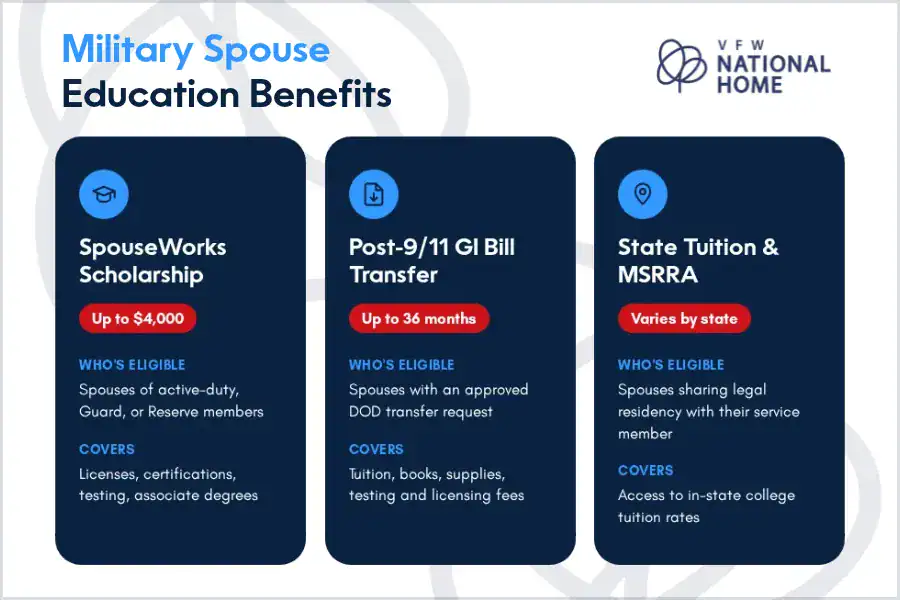
Formerly known as MyCAA, the SpouseWorks Scholarship offers up to $4,000 in tuition assistance to eligible military spouses pursuing licenses, certifications, national testing, continuing education credits, or an associate degree tied to a career field. The scholarship is meant to fund a specific credential or degree path tied to a career field, not general coursework.
- Who’s eligible: Spouses of active-duty, National Guard, and reserve service members across all branches, serving under qualifying Title 10 orders, across all ranks and pay grades.
- Where to start: Visit the SpouseWorks program portal to check eligibility and begin the application process.
Post-9/11 GI Bill transferability
A service member with unused Post-9/11 GI Bill benefits can transfer up to 36 months of their remaining education benefits to their dependents, including their spouse, who can use them right away. Transferred benefits can go toward tuition, books and supplies, fees for national standardized tests, and fees for licensing and certifications.
Payment amounts for transferred benefits depend on several factors and can change. Spouses can check current rates directly on VA.gov before making enrollment decisions.
- Who’s eligible: Spouses of service members whose transfer request has been approved by the Department of Defense while the member is still serving.
- Where to start: Eligible service members can transfer benefits by:
- While still on active duty, requesting a Transfer of Education Benefits (TEB) from the DOD through milConnect.
- The service member’s eligible dependent must apply to use the transferred benefits through their own ID.me or Login.gov account.
State tuition assistance and legal residency protections
The Military Spouse Residency Relief Act (MSRRA) lets military spouses keep their home-state residency after a move. Many states use that residency status to decide who qualifies for in-state college tuition. Rules vary, so we recommend checking directly with the specific state and school. Spouses can also find broader career and education counseling resources through VA’s family benefits hub.
- Who’s eligible: Spouses who share legal residency with their service member, established under the MSRRA, which allows a spouse to claim the same state of legal residency for tax and voting purposes regardless of where they’re currently stationed.
- Where to start: Confirm current in-state tuition policy directly with the target school, since rules for tying tuition rates to legal residency vary by state and by institution.
VFW National Home’s on-campus education program
The previously mentioned benefits can go a long way toward funding a class, certification, or degree. For some families, there’s also a need for broader support alongside that, like housing stability or a fresh path forward after frequent moves.

VFW National Home offers an on-campus program in Eaton Rapids, Michigan, where families work through the phased Red, White & Blue Program while living in a supportive residential community. Education support is built into that experience at every age:
- Academic tutoring
- A computer lab and library
- Teen and adult life skills programming, covering study habits to financial management
Adult residents can use these same resources to work toward school, career, or life goals of their own, alongside their children. It works alongside programs like the SpouseWorks Scholarship and GI Bill benefits, supporting the whole family.
Find the right next step
If your family is ready to build toward long-term stability, our on-campus program pairs military spouses with a case manager to set education goals within the phased Red, White & Blue Program.
Get On-Campus Education SupportFrequently asked questions (FAQs)
What is the SpouseWorks Scholarship formerly known as?
The SpouseWorks Scholarship was previously called MyCAA, or the Military Spouse Career Advancement Account. The program itself hasn’t fundamentally changed, but spouses researching it may still find it listed under either name.
Can a military spouse use GI Bill benefits while the service member is still on active duty?
Yes. Transferred Post-9/11 GI Bill benefits can be used while the service member is still serving.
How much can the SpouseWorks Scholarship provide?
Eligible spouses can receive up to $4,000 toward a qualifying license, certification, or associate degree.
Does a military spouse need to live on a military base to qualify for education benefits?
No. Programs like the SpouseWorks Scholarship and GI Bill transfer are tied to the service member’s status and orders, not where the family lives. Spouses can qualify regardless of location, as long as service and eligibility requirements are met.
What other support is available for military families besides education benefits?
Families facing bigger challenges like housing instability may want to look into VFW National Home’s on-campus program, which combines education support with broader case management and a structured path toward long-term stability.