
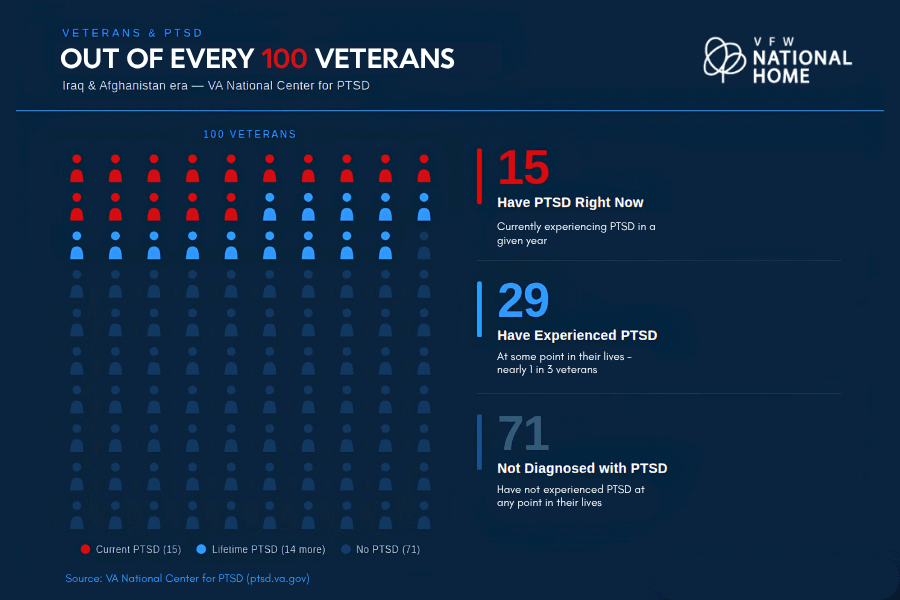
- Roughly 15% to 29% of veterans from the Iraq and Afghanistan wars experience post-traumatic stress disorder in any given year.
Read full summary ▾
- Traumatic stress alters the physical biology of the brain, trapping the nervous system in a perpetual survival mode that mistakenly registers normal environments as active threats.
- Multiple combat tours severely compound the risk of long-term trauma, especially when service members spend less than 12 months at home between deployments.
- Evidence-based clinical treatments, including Cognitive Processing Therapy and Prolonged Exposure, consistently yield measurable psychological improvement.
This article covers everything from what military PTSD actually is and who is most at risk to how it ripples through families and what treatment and support options are available. Whether you’re a veteran trying to make sense of what you’re experiencing or a family member trying to help, you’ll find clear, honest answers here.
Post-traumatic stress disorder is one of the most common conditions affecting veterans today, and one of the most misunderstood. According to the VA National Center for PTSD, 15 out of every 100 veterans who served in Iraq and Afghanistan experience PTSD in a given year, and 29 out of 100 have experienced it at some point in their lives.
Behind every one of those numbers is a family trying to make sense of something they may not fully understand yet. This article explains what military PTSD is, what causes it, how to recognize the signs, and where to find help.
If you or a loved one is experiencing an immediate crisis, please call or text 988 right away to reach the Veterans Crisis Line (available 24/7, free, and confidential).
Table of contents
- What is military PTSD?
- What causes PTSD in military veterans?
- What are the signs and symptoms of military PTSD?
- Which service members are most vulnerable to PTSD?
- How does military PTSD affect the whole family?
- What are the treatment options for military PTSD?
- How does VFW National Home support veterans with PTSD?
- Frequently asked questions (FAQs)
What is military PTSD?
PTSD (post-traumatic stress disorder) is a mental health condition that can develop after experiencing or witnessing a traumatic event. For veterans, that often means combat, but it can also stem from life-threatening training accidents or the grief of losing fellow service members.
What sets PTSD apart from ordinary stress is how it changes the brain’s relationship with fear. After repeated exposure to danger, the brain can get stuck in survival mode, continuing to scan for threats even when none exist. Crowded spaces, sudden loud noises, or certain smells can trigger the same physiological response as actual danger.
According to the U.S. Department of Veterans Affairs, about 7% of veterans will develop PTSD at some point in their lives, with rates significantly higher among veterans who served in combat roles.
What causes PTSD in military veterans?
PTSD develops when traumatic experiences become too much for the brain to fully process and move past. The following are among the most common contributing factors for veterans:
- Direct combat exposure: Firefights, ambushes, witnessing casualties, or making decisions under fire with life-or-death consequences.
- Blast injuries and high-threat environments: Surviving IED explosions or operating in sustained danger for months at a time.
- Loss of fellow service members: Particularly deaths that felt sudden, senseless, or preventable, which can also trigger survivor’s guilt.
It’s also worth noting that trauma can be cumulative. Veterans who experienced adversity before enlisting (childhood trauma, for example) may be at higher risk for PTSD after service, as prior trauma can lower the threshold for what the brain can absorb and recover from.
What are the signs and symptoms of military PTSD?
PTSD symptoms generally fall into four categories recognized by the American Psychiatric Association:
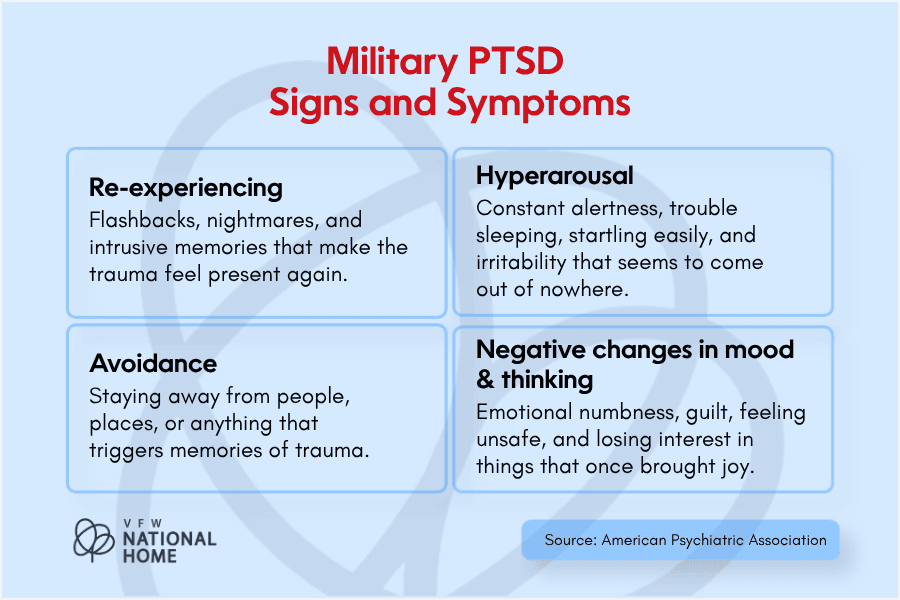
- Re-experiencing: Flashbacks, intrusive memories, and nightmares that make the traumatic event feel like it is happening again, sometimes triggered by something as ordinary as fireworks or a scene in a movie.
- Avoidance: Steering clear of places, people, or conversations that bring up memories of trauma. This can mean avoiding the news, crowds, or anything associated with deployment, sometimes to the point of withdrawing from daily life.
- Hyperarousal: Constant alertness, scanning rooms for exits, startling easily at loud sounds, difficulty sleeping, and irritability that seems to come out of nowhere.
- Negative changes in mood and thinking: Emotional numbness, withdrawing from loved ones, persistent feelings that the world is unsafe, guilt, or losing interest in things that once brought joy.
In everyday life, these symptoms can show up in ways that are easy to misread. For example, a veteran might not want to sit with their back to the door or may avoid driving under overpasses. A veteran parent might seem emotionally distant even in calm, safe moments at home. For families, recognizing these patterns as symptoms rather than personality flaws makes it easier to respond with patience.
Symptoms typically begin within three months of a traumatic event, though in some cases they don’t surface until years later.
Which service members are most vulnerable to PTSD?
Exposure to trauma doesn’t automatically lead to PTSD, and some veterans come through difficult experiences without lasting effects. But certain factors do increase the likelihood of a lasting PTSD diagnosis.
Personnel facing multiple deployments
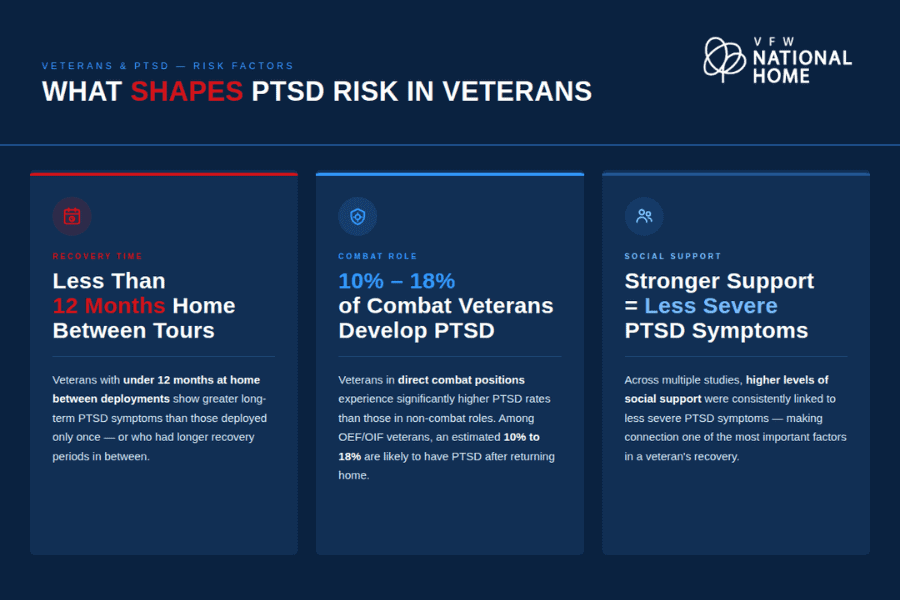
Repeated exposure to trauma leaves less time for the nervous system to recover between tours. Research has also found that the time spent at home between deployments or dwell time has a large impact on a veteran’s PTSD symptoms. Veterans who had less than 12 months at home between tours showed greater long-term PTSD symptoms than those deployed only once or who had longer recovery periods in between.
Personnel serving in combat and high-exposure roles
Veterans in direct combat positions experience higher rates of PTSD than those in non-combat roles. Research on OEF/OIF veterans suggests that between 10% and 18% are likely to have PTSD after returning home, a rate that climbs higher among those in frontline, medical, or explosive ordnance disposal (EOD) roles.
Veterans experiencing isolation after returning home
A meta-analysis of nearly 19,000 veterans and service members found that higher levels of social support were consistently associated with less severe PTSD symptoms, and that support from civilians and the home environment played a greater protective role than support from military sources.
A stable home, a supportive community, and access to the right resources can meaningfully shape a veteran’s recovery path. That’s at the core of what VFW National Home’s programs are built to provide: stable housing, community, and wraparound support for veterans and their families during some of the hardest transitions of their lives.
How does military PTSD affect the whole family?
Spouses often describe walking on eggshells, such as carefully managing the tone of conversations, the volume of the TV, and anything that might trigger a sudden reaction. Over time, that constant vigilance can transfer to them. Researchers call this secondary traumatic stress, and it’s a recognized condition with its own symptoms that mirror those of PTSD itself.
Children feel the weight of it too. When a parent seems emotionally distant or unpredictable, children often assume it is their fault. They may become anxious, clingy, or begin acting out at school as an expression of the tension they are absorbing at home. The VA’s National Center for PTSD has documented the ripple effects of veteran PTSD on children and partners extensively, noting that family members frequently need their own support.
What are the treatment options for military PTSD?
The goal of treatment is not to forget what happened. It is to change how the brain and body respond to those memories so they lose their grip on daily life. The good news is that PTSD is treatable, and research from the VA shows that most people who engage in evidence-based therapy see meaningful improvement.
Evidence-based therapies
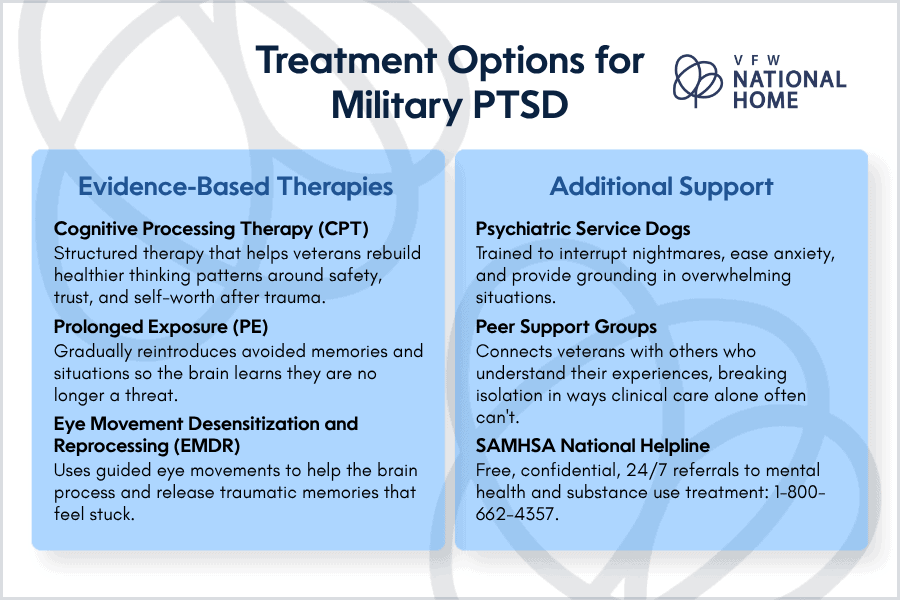
- Cognitive Processing Therapy (CPT): A structured 12-session therapy that helps veterans examine how trauma reshaped their beliefs about safety, trust, control, and their own worth, and rebuild more grounded, balanced thinking. Both the VA and Department of Defense clinical practice guidelines recommend CPT as a first-line treatment for PTSD. Results vary by person, but VA research on CPT outcomes found that 40% of veterans who completed CPT no longer met the criteria for PTSD by the end of treatment, with the majority experiencing meaningful reductions in symptoms, depression, and anxiety.
- Prolonged Exposure (PE): A therapy that gradually and safely reintroduces avoided memories and situations so the brain can learn, over time, that they are no longer dangerous. PE is one of the most studied PTSD treatments available. In a randomized clinical trial of PE in military personnel and veterans, 61% achieved clinically significant reductions in PTSD symptoms, and more than 50% maintained full diagnostic remission at the six-month follow-up.
- Eye Movement Desensitization and Reprocessing (EMDR): A technique that uses bilateral stimulation (typically guided side-to-side eye movements) to help the brain process and release traumatic memories that feel stuck. EMDR is recognized in WHO guidelines for trauma and stress-related conditions as an effective treatment for PTSD in adults. In a study, 77.7% no longer met the criteria for PTSD after 12 sessions, with results maintained at both three- and nine-month follow-ups.
Additional support
- Service dog programs: Psychiatric service dogs are trained to interrupt nightmares, provide grounding during anxiety episodes, and create a physical buffer in crowded or overwhelming spaces. Organizations like Paws and Stripes pair veterans specifically with PTSD-trained dogs.
- Peer support groups: Connecting with other veterans who have been through similar experiences breaks through isolation in a way that clinical settings alone often cannot. Shared understanding matters. The VA’s peer support program and community-based organizations both offer veteran-specific groups.
- SAMHSA National Helpline: 1-800-662-4357 – free, confidential, and available 24/7 for referrals to mental health and substance use treatment services, in English and Spanish.
For veterans and families looking for housing stability and wraparound community support alongside mental health care, VFW National Home’s veteran and family programs offer a foundation that many veterans find essential to lasting recovery.
How does VFW National Home support veterans with PTSD?
Therapy is essential, but therapy alone can’t stabilize a home environment, resolve a financial crisis, or replace a support network that doesn’t exist. Those circumstances make recovery much harder, and they’re exactly what VFW National Home is set up to address.
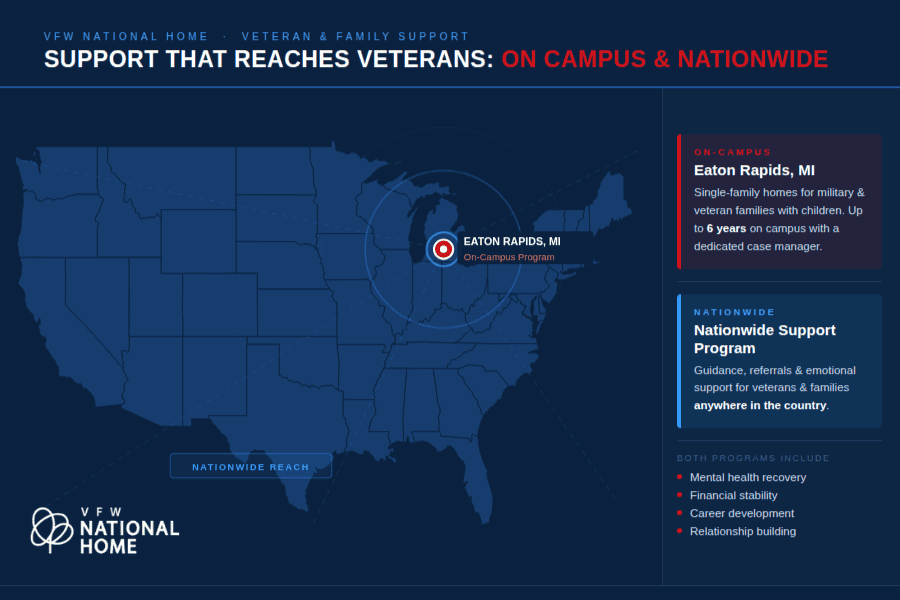
VFW National Home offers on-campus housing and wraparound support for military and veteran families with children. Families live in single-family homes on a campus in Eaton Rapids, Michigan for up to six years, working alongside a dedicated case manager to build the stability and skills they need for life beyond campus. Goals commonly include mental health recovery, financial stability, career development, and relationship building.
For families who aren’t relocating to campus, our Nationwide Support Program connects veterans and families with guidance, referrals, and emotional support wherever they are in the country.
Get connected to support
VFW National Home exists to help military and veteran families find stability, access resources, and move forward. If you or someone you know needs support, reach out today.
Frequently asked questions (FAQs)
Can military PTSD be cured?
PTSD may not have a “cure” in the traditional sense, but it is treatable. Most veterans who engage in evidence-based therapies like CPT, PE, or EMDR see a meaningful reduction in symptoms and can return to a fuller, more functional life.
How long does military PTSD last?
It varies. Some veterans see significant improvement within months of starting treatment. Others manage symptoms over years. Without treatment, PTSD rarely resolves on its own and often worsens over time. The VA’s National Center for PTSD notes that early intervention improves outcomes.
Can family members develop PTSD from living with a veteran who has it?
Yes. Spouses and children of veterans with PTSD can develop secondary traumatic stress, a condition with symptoms that closely mirror PTSD itself. Family members benefit from their own support and counseling, not just the veteran. VFW National Home’s programs are built around the whole household for this reason.
Does the VA cover PTSD treatment?
Yes. The VA provides free mental health care for PTSD, including therapy, medication, and support programs. Veterans can walk into any VA medical center for a mental health assessment regardless of their discharge status or whether they are enrolled in VA health care.
What is the difference between PTSD and normal stress after military service?
Normal stress after deployment typically fades within weeks as a veteran readjusts to civilian life. PTSD persists for more than a month, significantly disrupts daily functioning, and does not improve without treatment. If symptoms are interfering with work, relationships, or daily life, the VA’s PTSD treatment locator can help find care. VFW National Home’s support resources are also available for veterans and families who need a place to start.