
- A military dependent is an eligible family member whose documented relationship to a service member entitles them to unique benefits and legal protections.
Read full summary ▾
- Dependent status is not automatic. A sponsor must formally register their family members in the Defense Enrollment Eligibility Reporting System (DEERS) to unlock benefits.
- Dependent children are generally eligible for benefits until age 21, but this coverage can be extended until age 23 if they are full-time college students.
- Registered dependents gain access to specific privileges, including TRICARE healthcare, tax-free base exchange and commissary shopping, and specialized defense education systems.
We talk about the specific eligibility criteria, multi-step registration processes, and health and educational benefits that come with military dependent status. We also discuss the legal protections and financial survivor frameworks that keep military families secure when circumstances shift.
When a service member joins the military, their family becomes part of that commitment too. Spouses, children, and other specific family members may qualify as military dependents: a formal status that opens the door to healthcare, housing support, education, legal protections, and more.
But gaining dependent status isn’t automatic. It has to be documented and registered through official channels. Taking the time to get everything in place can make it easier for your family to access the resources and support available sooner.
Table of Contents
- What is a military dependent?
- Who qualifies as a military dependent?
- How does a dependent get registered?
- What benefits do military dependents receive?
- What are the legal protections for military dependents?
- When does military dependent status end?
- Frequently asked questions (FAQs)
What is a military dependent?
A military dependent is a family member whose relationship to a service member entitles them to certain benefits and privileges. Dependents may include spouses, children, and, in some cases, other eligible family members. These benefits can include access to healthcare, education programs, military installations, and other support services provided by the military.

What is a sponsor?
The service member is called the sponsor. The sponsor’s branch of service (Army, Navy, Air Force, Marines, Coast Guard, or Space Force) determines who qualifies as a dependent and what benefits apply. It’s the sponsor’s uniformed service that decides eligibility and reports it to the federal tracking system.
That system is called the Defense Enrollment Eligibility Reporting System (DEERS). If you’re not in DEERS, you can’t access military benefits. We’ll cover how enrollment works below.
Who qualifies as a military dependent?
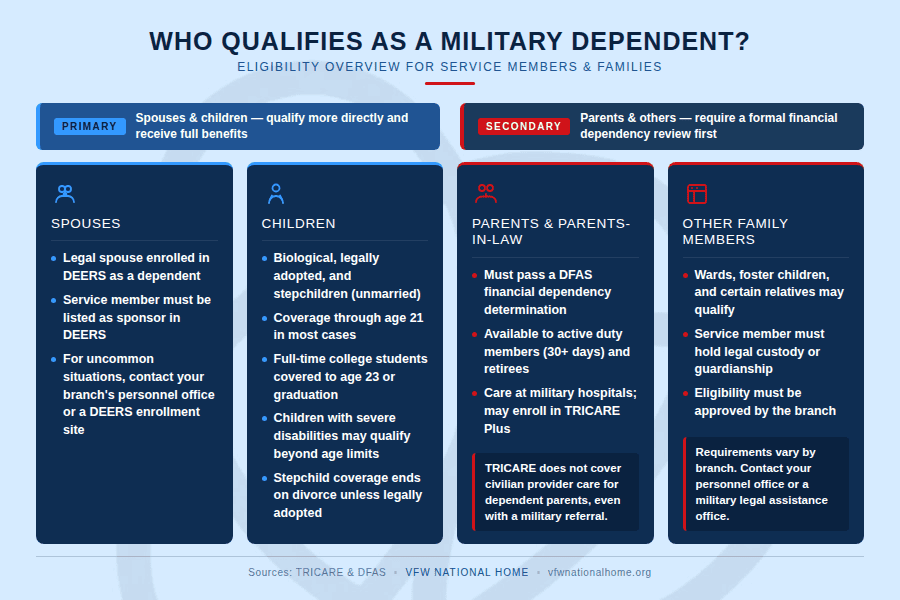
There are two tiers of military dependents:
- Primary dependents are spouses and children, who qualify more directly.
- Secondary dependents are parents and certain others, who go through a formal financial review process first.
Spouses
A legal spouse is the most straightforward category. To receive benefits, a spouse must be listed in DEERS as the service member’s dependent, with the service member listed as their sponsor.
If your situation is less common (for example, if you have questions about how your marriage is recognized under current DoD policy), your branch’s personnel office or the nearest DEERS enrollment site is the right place to get a clear answer.
Children
For children, eligible dependents include unmarried biological children, legally adopted children, and stepchildren. In most cases, dependent status and associated benefits remain in effect until the child reaches age 21.
- There is an extension for college students: a child can stay covered until their 23rd birthday or graduation, whichever comes first, as long as they are enrolled full-time and the sponsor provides more than half of their financial support.
- Children with severe disabilities may qualify for coverage beyond those age limits. Contact your branch’s ID card office to find out what documentation is needed.
- Stepchildren are covered while the sponsor and the child’s parent are married. If the marriage ends, a stepchild loses eligibility on the date the divorce is final. An exception is that if the sponsor has legally adopted the stepchild, coverage continues as an adopted child even after a divorce.
Parents and parents-in-law
Parents and parents-in-law can qualify, but the process takes more steps. The sponsor must go through a financial dependency determination, which is a review confirming the parent relies on the service member for financial support.
If you’re on active duty for more than 30 days, or if you’re retired, you can apply to have a dependent parent or parent-in-law receive care at military hospitals and clinics, and to enroll in TRICARE Plus where it’s available.
Note that their benefits are more limited than those of spouses and children. Specifically, TRICARE will not pay for civilian provider care for dependent parents, even when a military hospital makes the referral.
To get started, contact the DFAS Secondary Dependency Office for your branch.
Other family members
In certain circumstances, wards, foster children, and other relatives may also qualify, but only if the service member holds legal custody or guardianship and the branch approves the claim.

How does a dependent get registered?
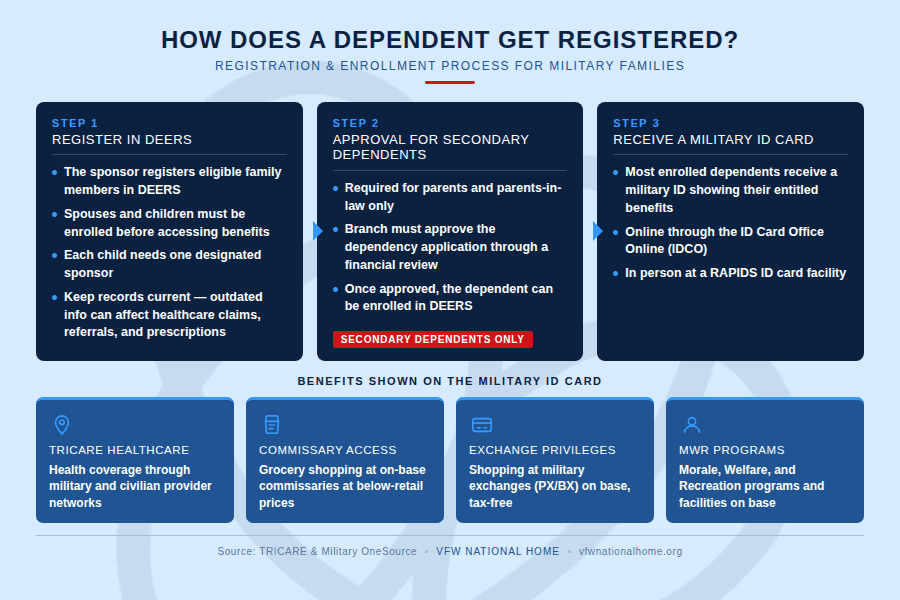
Before a family member can access military benefits, they have to be enrolled in the DEERS. Enrollment for this does not happen automatically.
These are the steps to follow to register a dependent:
Step 1: Register the dependent in DEERS
The service member (sponsor) is responsible for registering eligible family members.
- Spouses and children must be entered into DEERS before they can receive benefits.
- Each child needs one designated sponsor in the system, so if both parents are service members, they can pick which parent fills that role for each child.
- It is important to keep DEERS records current. Incorrect or outdated information can cause issues with:
- Healthcare claims
- Medical referrals
- Prescription deliveries
- Other military benefits and services
Step 2: Get approval for secondary dependents
For secondary dependents, such as parents, an additional step is required:
- The military branch must first approve the dependency application through a financial review process.
- Once approved, the dependent can then be enrolled in DEERS.
Step 3: Receive a military ID card
Once enrolled, most dependents receive a military ID card. The card shows which benefits the dependent is entitled to, which can include:
- TRICARE healthcare coverage
- Commissary access
- Exchange privileges
- Morale, Welfare, and Recreation (MWR) programs
Cards can be obtained:
- Online through the ID Card Office Online system
- In person at a RAPIDS ID card facility.
What benefits do military dependents receive?
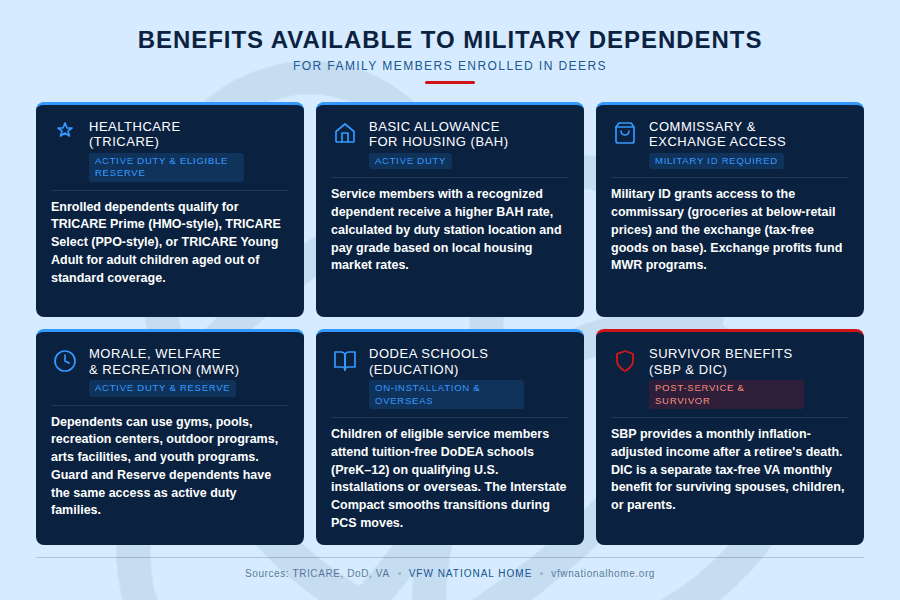
Once a family member is in DEERS, they may be eligible for the following:
Healthcare (TRICARE)
Active duty service members and their families registered in DEERS are eligible for TRICARE. The plan options available to a family depend on the sponsor’s duty status and duty station location.
The main options for dependents are usually the following:
- TRICARE Prime works like a Health Maintenance Organization (HMO). Dependents are assigned a primary care manager and generally receive care at a military treatment facility.
- TRICARE Select works more like a Preferred Provider Organization (PPO). Dependents can see any TRICARE-authorized provider with more flexibility but some out-of-pocket costs.
- TRICARE Young Adult is a premium-based plan for dependent adult children who have aged out of standard coverage at 21 or 23.
- Family members can also purchase TRICARE Dental Program coverage separately.
Premium amounts change each year. For current costs and a plan comparison, visit TRICARE’s Plans page.
Basic Allowance for Housing (BAH)
A service member with a recognized dependent receives a higher Basic Allowance for Housing (BAH) than one without. BAH is meant to cover the cost of housing near the duty station and is calculated based on local market rates, so it depends on location and pay grade.
Commissary and Exchange Access
A military ID card grants dependents access to the commissary and exchange.
- The commissary, run by the Defense Commissary Agency, sells groceries and household goods at lower civilian retail prices.
- The exchange sells tax-free goods on base. Profits from the exchange fund Morale, Welfare, and Recreation programs across military installations.
Morale, Welfare and Recreation (MWR)
MWR programs are available to dependents and include the following:
- Gyms
- Pools
- Recreation centers
- Outdoor programs
- Arts facilities
- Youth programs.
Guard and Reserve dependents are generally eligible to use the same MWR facilities as active duty families.
Education: DoDEA Schools
For families at eligible U.S. installations or stationed overseas, children can attend Department of Defense Education Activity (DoDEA) schools – a network of PreK-12 schools run by the Department of Defense on military installations in the U.S. and abroad, specifically for the children of service members and DoD civilian employees.
DoDEA runs PreK through 12th grade education for eligible military dependents through two systems: DDESS schools at eligible domestic installations, and DoDDS schools overseas
Who qualifies for DoDEA School Systems?
Children qualify for tuition-free enrollment if they are dependents of active duty service members living in permanent quarters on the installation, including activated National Guard and Reserve members on Title 10 orders.
Through the 2025 National Defense Authorization Act, an Expanded Eligibility Enrollment option now allows children of active-duty families living off-installation to attend a DoDEA school at select locations, on a space-available basis.
Support during PCS moves
When families move due to PCS orders, the Interstate Compact on Educational Opportunity for Military Children helps smooth transitions. All 50 states, D.C., and DoDEA participate and work together on enrollment, course placement, and graduation requirements across state lines.
Survivor Benefits: Survivor Benefit Plan (SBP) and Dependency and Indemnity Compensation (DIC)
When a service member or retiree passes away, their dependents have access to financial support through two programs.
Survivor Benefit Plan (SBP)
The Survivor Benefit Plan (SBP) lets a retiring service member set aside a portion of their retirement pay so that their dependents keep receiving a monthly, inflation-adjusted income after their death.
The SBP covers children as long as they are the service member’s legal, unmarried children and are under 18, or older than 18 and enrolled in an accredited college or university. Payments end at 18, or at 22 for full-time students.
One significant change took effect in 2023: Before that year, surviving spouses receiving both SBP and VA Dependency and Indemnity Compensation had their SBP reduced by the amount of DIC they received. Starting February 1, 2023, surviving spouses receive both in full.
Dependency and Indemnity Compensation (DIC):
Dependency and Indemnity Compensation (DIC) is a tax-free monthly benefit from the VA for surviving spouses, children, or parents of a service member who died in the line of duty, or a veteran who died from a service-related injury or illness.
- Surviving children may also be eligible if they are unmarried and under 18, or under 23 if enrolled full-time in school.
- Surviving parents may qualify as well, though their benefit is income-based.
- To apply, surviving spouses and children use VA Form 21P-534EZ. Surviving parents use VA Form 21P-535.
DIC rates are adjusted each December to account for cost-of-living changes. For the most current figures, check the VA’s DIC rate table directly.
What are the legal protections for military dependents?
Military families have legal protections, particularly around housing and financial obligations during service. These legal protections include:
Servicemembers Civil Relief Act (SCRA)
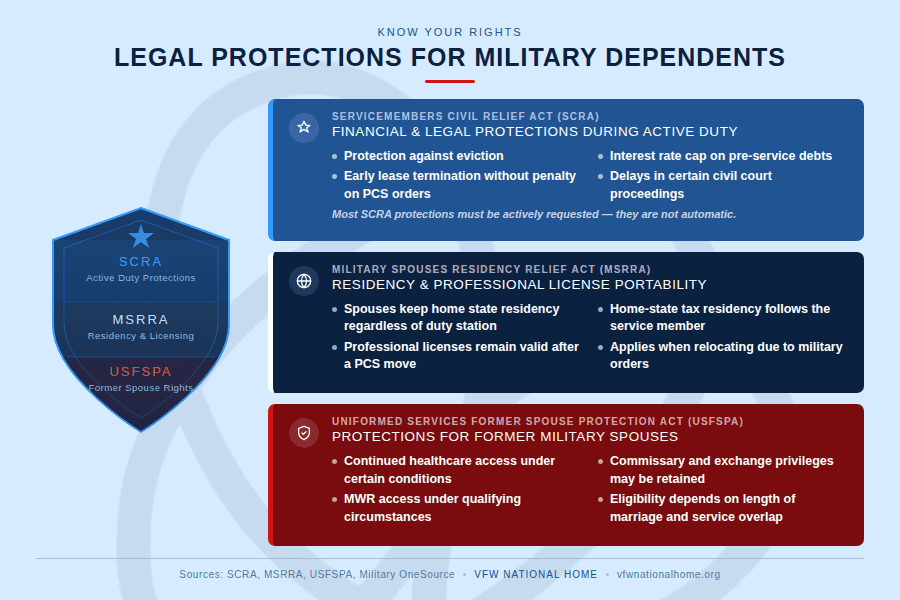
The Servicemembers Civil Relief Act (SCRA) provides financial and legal protections for active duty service members and their families. Many of those protections extend to spouses and dependents and include:
- Protection against eviction
- The ability to end a lease early without penalty when PCS orders require a move
- Delays in certain civil court proceedings
- Interest rate caps on debts taken on before active duty
Dependents can contact a local military legal assistance office for help with their specific situation. Most SCRA protections are not automatic and need to be requested first.
Military Spouses Residency Relief Act (MSRRA)
The Military Spouses Residency Relief Act (MSRRA) allows military spouses to keep the same state of legal residency as their service member, no matter where they are stationed. It also lets spouses use professional licenses from their home state when they relocate due to military orders.
Divorce and former spouse protections
The Uniformed Services Former Spouse Protection Act provides certain benefits to former spouses of military members, which can include continued access to:
- Healthcare
- Commissary
- Exchange
- MWR privileges under specific conditions
The rules are detailed, so visit Military OneSource for the full breakdown.
When does military dependent status end?
Dependent status isn’t permanent and can change as a person’s circumstances change. The exact rules depend on the situation, but military dependent status most commonly ends under the following circumstances:
- Children lose dependent status at 21 or at 23 if they are a full-time college student who depends on the sponsor for more than half of their financial support.
- Children receiving SBP stop receiving payments at 18 or at 22 if enrolled full-time in school.
- Stepchildren lose eligibility on the date a divorce is finalized, unless they have been legally adopted by the sponsor.
- DoDEA enrollment ends when the sponsor is no longer on active duty or when the family moves off the installation.
- After a divorce, former spouse benefits are governed by separate federal law with specific eligibility requirements. Military OneSource has a dedicated guide worth reading before making any assumptions about what carries over.
Still have questions about your family’s benefits?
This article covers the basics, but every family’s situation is different. If you’re not sure what applies to your situation, or you’ve hit a wall trying to access benefits you know you should have, our veteran services team is available to help.
At VFW National Home, we offer free guidance and referrals to military and veteran families across the country through our Nationwide Support program, so don’t hesitate to reach out.
Frequently asked questions (FAQs)
What qualifies you as a military dependent?
You qualify as a military dependent if you have a qualifying relationship to an active duty, retired, or deceased service member and are registered in DEERS. Qualifying relationships include spouses, unmarried children under 21 (or 23 if full-time students), and in some cases, parents and other relatives.
What are the US dependents of military personnel?
Military dependents are family members whose relationship to a service member entitles them to certain benefits and privileges, such as healthcare through TRICARE, commissary access, and housing support. The service member’s branch of service determines who qualifies and what benefits apply.
At what age are you no longer a military dependent?
Most children lose dependent status at 21, or at 23 if they are enrolled full-time in college and the service member provides more than half of their financial support. Children with severe disabilities may qualify for continued coverage beyond those limits.
What are the benefits of being a military dependent?
Military dependents (spouses, children, and sometimes parents) can access benefits like TRICARE health coverage, commissary and exchange shopping privileges, education assistance, and a military ID card for base access and recreation programs. Some may also qualify for housing allowances, life insurance, and counseling support through Military OneSource. Exact eligibility depends on the sponsor’s status and the dependent’s relationship and age.
When a veteran dies, does his wife get his benefits?
Often, yes. A surviving spouse may qualify for Dependency and Indemnity Compensation (DIC), a Survivors’ Pension, CHAMPVA healthcare, or education benefits, depending on how and when the veteran passed away and their service record. Since eligibility depends on specific situations, the spouse should confirm specifics with a VA-accredited representative or at VA.gov.