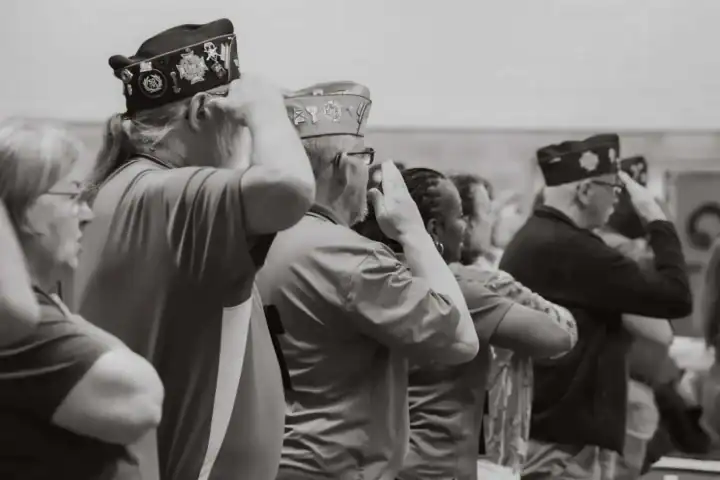
- A Gold Star family is the immediate family of a service member who died as a result of military service. The designation traces back to the service flags families displayed during World War I.
Read full summary ▾
- The military issues two different lapel buttons to families of fallen service members, and the circumstances of the service member’s death determine which one a family receives.
- Most eligible families receive the Gold Star Lapel Button automatically, but family members who never received one can still request it.
- Survivors may qualify for financial, housing, health care, and education benefits, including a $100,000 tax-exempt death gratuity.
- The nation sets aside two observances each year to honor Gold Star families.
This guide explains what the Gold Star designation means and how a wartime custom became a formal recognition backed by federal law. It covers who qualifies for each lapel button, how to request or replace one, and the benefits and support available to surviving families. It also looks at the national observances that honor these families and the ways communities can stand with them.
A Gold Star family is the immediate family of a service member who died as a result of military service. The designation recognizes both the service member’s sacrifice and the family’s loss.
This guide covers where the term comes from, who qualifies for the Gold Star Lapel Button and Next of Kin Lapel Button, and what benefits and support are available to surviving families.
We’ll discuss the following:
- What is the meaning of “Gold Star family”?
- Where does the gold star tradition come from?
- When does the nation honor Gold Star families?
- Who qualifies as a Gold Star family?
- How do families receive or replace a Gold Star Lapel Button?
- What benefits and support are available to Gold Star families?
- How can communities support Gold Star families?
- Frequently asked questions
VFW National Home was founded in 1925 to fulfill the VFW promise to “honor the dead by helping the living.” Donations help carry that promise forward, supporting military and veteran families on campus in Eaton Rapids, Michigan, and across the country.
Donate to Support Military FamiliesWhat is the meaning of “Gold Star family”?
A Gold Star family is the immediate family of a fallen service member – someone who died as a result of military service. The designation honors the service member’s sacrifice while recognizing the family’s loss. Spouses, parents, children, and siblings can all be part of a Gold Star family, and individual members are often recognized by name, as in “Gold Star mothers” or “Gold Star wives.”
Where does the gold star tradition come from?
The gold star tradition began during World War I. Families flew a service flag with a blue star for each immediate family member in uniform, and the star became gold if that loved one died in the war. It was a signal to neighbors that the household had suffered a loss.
Over the following decades, the custom moved from front windows into federal law. In 1942, Congress authorized a standard service flag design, along with a service lapel button. In 1947, it created the Gold Star Lapel Button for the widows, parents, and next of kin of those who died in World War II.
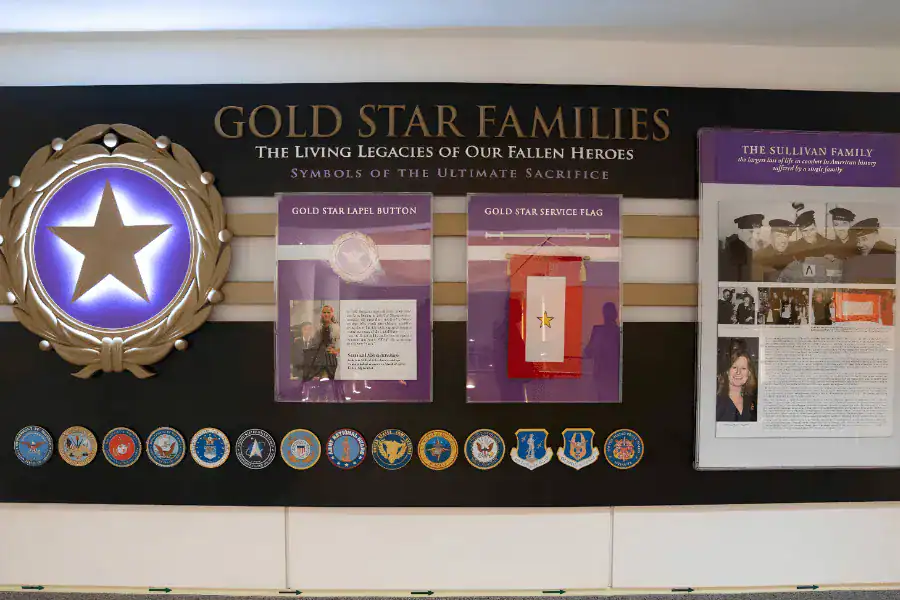
The Gold Star Families display at the Pentagon, Oct. 26, 2020. (DoD photo by Navy Petty Officer 1st Class Carlos M. Vazquez II)
When does the nation honor Gold Star families?
Two national observances are set aside for Gold Star families. Gold Star Mother’s and Family’s Day falls on the last Sunday in September, a date Congress first designated in 1936. Gold Star Spouses Day is April 5, honoring the spouses of those who died while serving on active duty.
Recognition also extends beyond those dates. The National Defense Authorization Act for 2022 authorized a free lifetime national parks pass for eligible Gold Star families. Before visiting, family members download and print a Gold Star Family Free Access Voucher to present at the site.
Who qualifies as a Gold Star family?
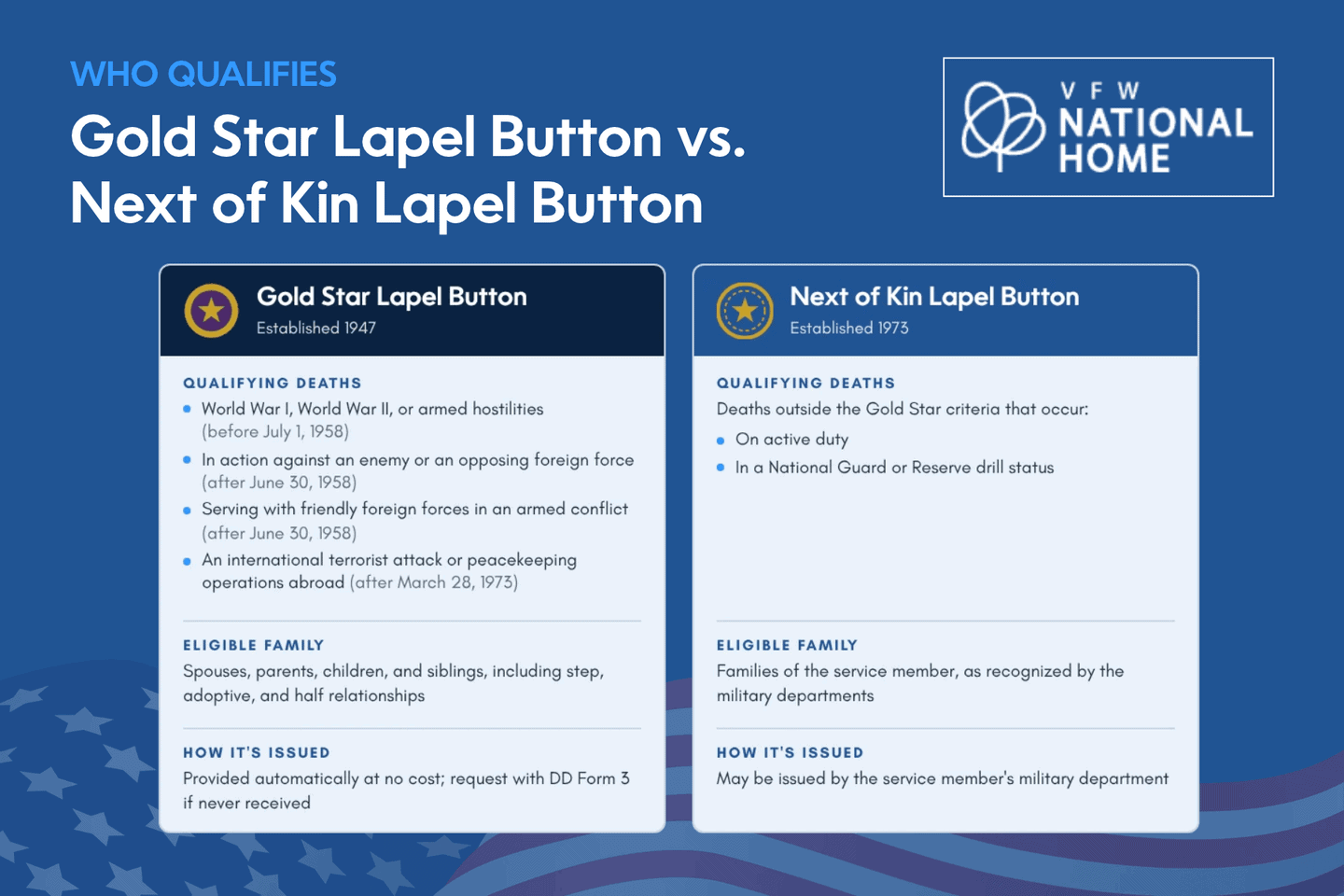
A lapel button is a small pin worn on a coat or jacket lapel. The military issues two different lapel buttons to families of fallen service members, and which one a family receives depends on how their loved one died. The Gold Star Lapel Button recognizes deaths in combat or other qualifying hostile circumstances. The Next of Kin Lapel Button recognizes other deaths on active duty or in a National Guard or Reserve drill status.
Gold Star Lapel Button
The official recognition for Gold Star families is called the Gold Star Lapel Button. A family member qualifies for it when two conditions are met:
- The service member died in one of the circumstances set by federal law
- The family member is one of the relatives the Defense Department defines as next of kin.
Families of service members who died in other circumstances may receive the Next of Kin Lapel Button instead.
Next of Kin Lapel Button
Under the federal Gold Star statute, the Gold Star Lapel Button goes to the next of kin of service members who:
- Died during World War I, World War II, or any later period of armed hostilities before July 1, 1958
- Died after June 30, 1958, while engaged in action against an enemy of the United States, while engaged in military operations involving conflict with an opposing foreign force, or while serving with friendly foreign forces in an armed conflict in which the United States wasn’t a belligerent party
- Died after March 28, 1973, as a result of an international terrorist attack against the United States or a friendly nation, or of military operations abroad as part of a peacekeeping force
Next of Kin eligibility
Defense Department policy defines eligible next of kin as:
- A surviving spouse, remarried or not
- Each parent, including stepparents, adoptive parents, and foster parents who stood in loco parentis
- Each child, stepchild, and adopted child
- Each sibling, half sibling, and stepsibling
How do families receive or replace a Gold Star Lapel Button?
Most eligible families don’t need to apply. The military service determines eligibility at the time of death and provides the button automatically, typically before the funeral or interment service, or shortly afterward.
Families who never received one, or who need a replacement, can request it through the following steps:
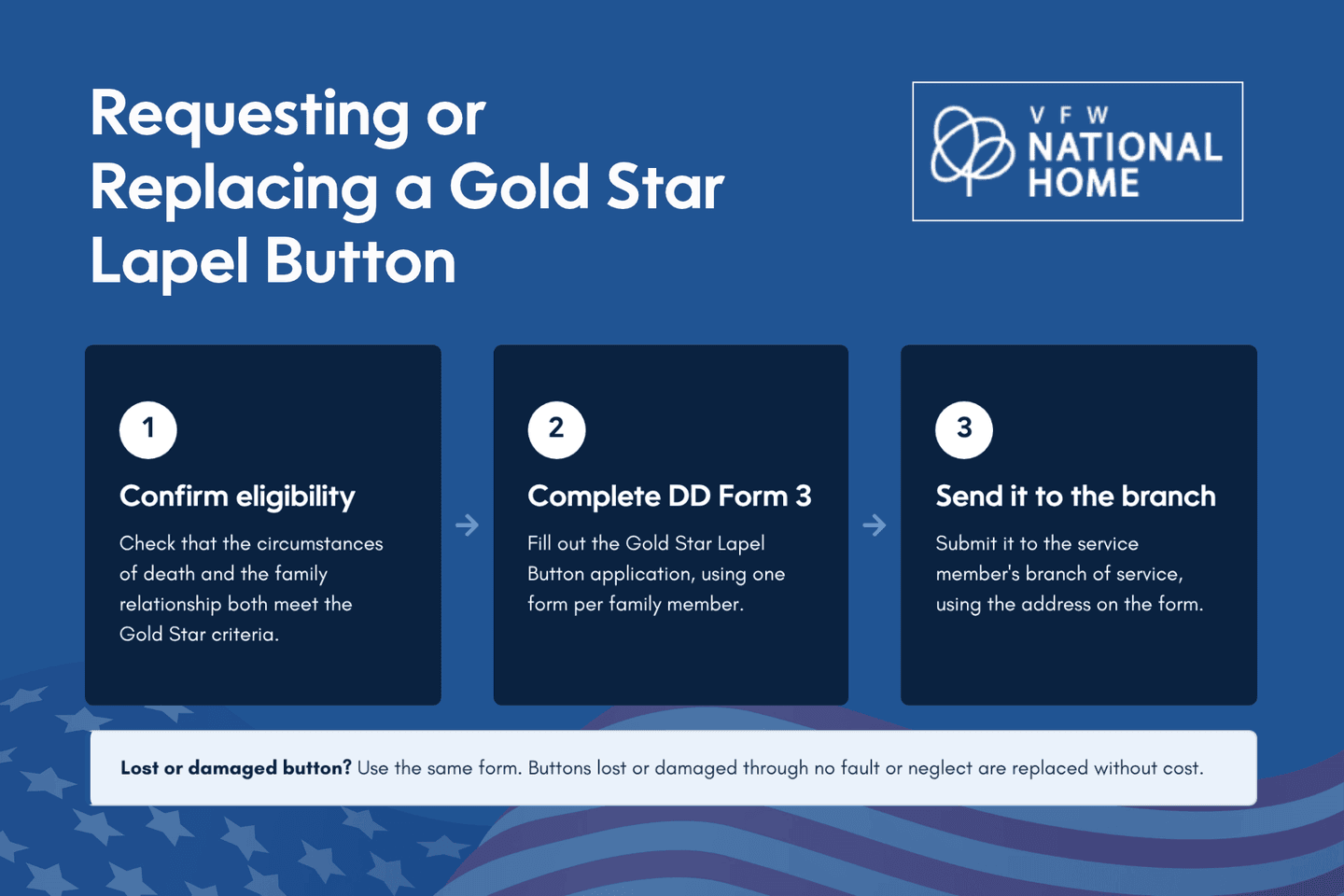
- Confirm eligibility. Check the qualifying circumstances and next-of-kin relationships above.
- Complete the Gold Star Lapel Button application (DD Form 3).
- Mail it to the service member’s branch of service, using the address listed on the form.
Use the same form for replacements. Federal law allows a lost, destroyed, or damaged button to be replaced without cost when the loss happened through no fault or neglect of the recipient.
Figuring out which benefits apply, and how to claim them, is a lot to manage while grieving. VFW National Home’s veteran services team can talk through a family’s circumstances and point them toward the next step.
Get Help With Survivor BenefitsWhat benefits and support are available to Gold Star families?
After a service member dies on active duty, the military assigns a casualty assistance officer to survivors to help them understand and receive the benefits they’re eligible for. Support generally includes financial payments, housing assistance, health care, education benefits, and long-term survivor programs. Each benefit has its own eligibility rules.
Financial benefits
Core military death benefits for survivors include:
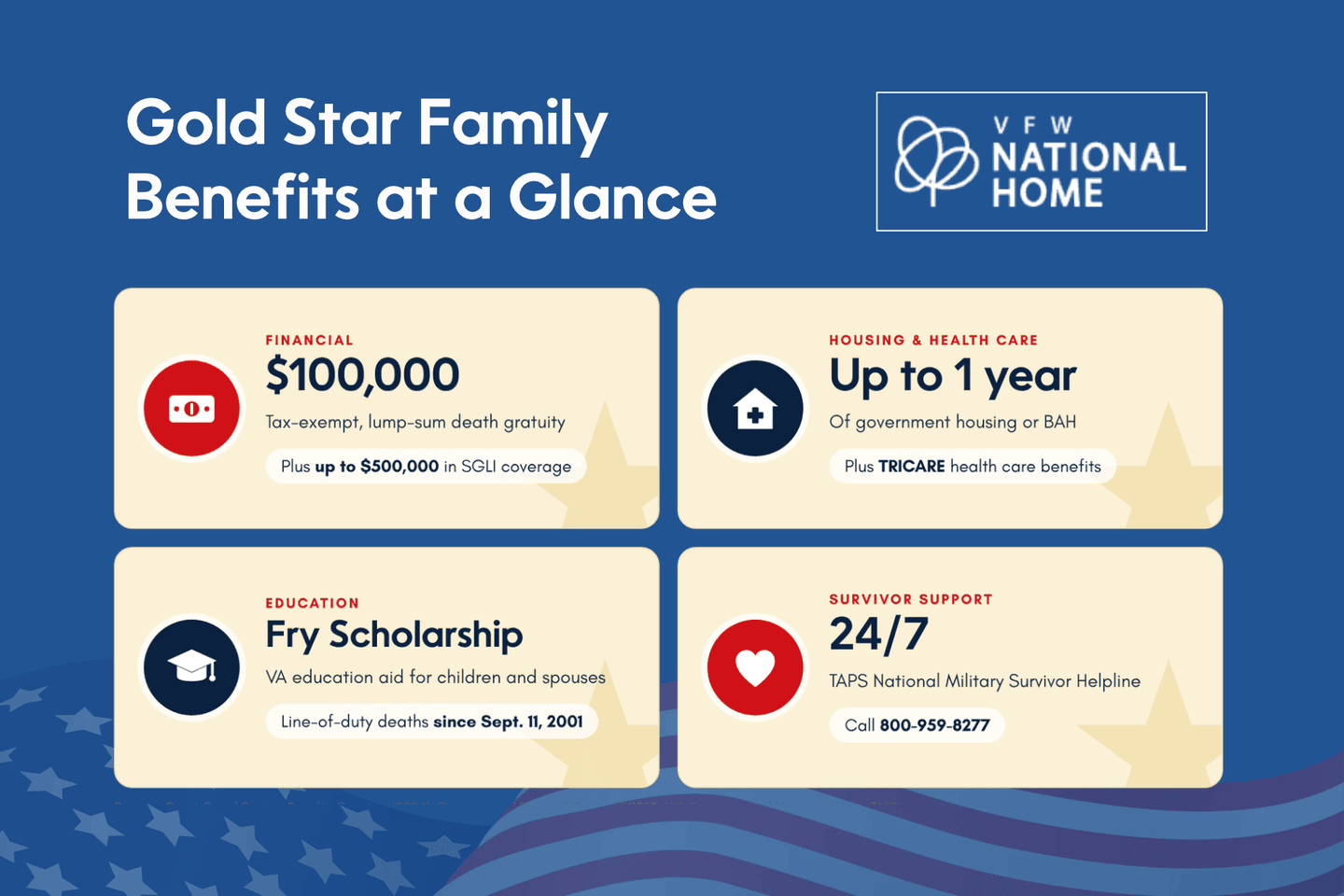
- A $100,000 tax-exempt death gratuity, paid as a lump sum to the beneficiaries the service member designated
- Servicemembers’ Group Life Insurance (SGLI) coverage of up to $500,000
Eligible surviving spouses, children, and parents may also qualify for VA Dependency and Indemnity Compensation (DIC), a tax-free monetary benefit.
Health care, housing, and other entitlements
Other survivor entitlements generally include:
- TRICARE health care benefits
- Government housing or Basic Allowance for Housing (BAH) for up to a year
- Access to commissaries and exchanges
- Burial assistance, including travel to the burial site for immediate family
- Survivor annuities such as the DoD Survivor Benefit Plan and Social Security survivor benefits
Education benefits
The Fry Scholarship provides VA education benefits to the children and surviving spouses of active-duty service members who died in the line of duty on or after September 11, 2001. A surviving spouse who remarries loses Fry eligibility. Families who qualify for both the Fry Scholarship and the Survivors’ and Dependents’ Educational Assistance (DEA) program generally have to choose one. The exception is a child whose parent died before August 1, 2011.
Survivor support programs
- Military branch programs: Army Survivor Outreach Services, for example, is available to Gold Star spouses for as long as they want it.
- TAPS: The Tragedy Assistance Program for Survivors runs a 24/7 National Military Survivor Helpline at 800-959-8277 for anyone grieving a military loss.
- Military OneSource: Survivors can send questions or concerns through its Survivor Family Member Inquiry Form.
How can communities support Gold Star families?
Support for Gold Star families works best when it’s steady and personal rather than limited to a single day each year. Small, consistent gestures from neighbors, employers, schools, and community groups can carry real weight long after the funeral is over.

- Say the service member’s name. Sharing a memory shows the family their loved one hasn’t been forgotten.
- Mark the observances. Reach out on Gold Star Mother’s and Family’s Day, Gold Star Spouses Day, and Memorial Day. Local VFW Posts have hosted events honoring Gold Star families, giving communities a way to show up in person.
- Point families to support. The VFW National Home’s veteran services team offers guidance and referrals to military and veteran families nationwide, including help understanding VA benefits.
- Create a lasting tribute. VFW National Home Tribute Bricks let supporters remember a loved one with a personalized brick on the National Home campus in Eaton Rapids, Michigan.
Support for military and veteran families
VFW National Home’s veteran services team helps military and veteran families understand which VA benefits apply to their circumstances and connects them with trusted resources, from mental health providers to local programs.
Frequently asked questions
What’s the difference between a Blue Star family and a Gold Star family?
A Blue Star family has an immediate family member currently serving in the armed forces, a tradition that comes from the blue star on the World War I service flag. A Gold Star family has lost a service member who died while serving. When that loss happens, the blue star on the family’s service flag gets a smaller gold star placed over it, so the blue forms a border.
Can extended family members wear the Gold Star Lapel Button?
The Gold Star Lapel Button is limited to the next of kin defined by the Defense Department: surviving spouses, parents, children, and siblings, including step, adoptive, and half relationships. Extended family members such as grandparents, aunts, uncles, and cousins aren’t on that list. Organizations like TAPS offer support to all grieving a military death, whatever their relationship.
Does a family lose Gold Star recognition over time?
No. Federal law doesn’t set an end date for the Gold Star Lapel Button, and a lost or damaged button can be replaced without cost. Individual benefits work differently, though. For example, BAH support lasts up to one year, and a surviving spouse who remarries loses Fry Scholarship eligibility.
Can a family qualify if their service member died outside combat?
Yes, in several cases. Deaths after March 28, 1973, from international terrorist attacks or peacekeeping operations abroad qualify for the Gold Star Lapel Button. Families of service members who died on active duty or in a Guard or Reserve drill status in other circumstances may receive the Next of Kin Lapel Button.
Where can Gold Star families find grief support?
The TAPS National Military Survivor Helpline (800-959-8277) is available 24/7 to anyone grieving a military loss. Each military branch also has its own Gold Star program, and Military OneSource offers survivor benefit guides and an inquiry form. For help understanding VA survivor benefits, the VFW National Home’s veteran services team can be reached at 800-424-8360.